Topics
>RESEARCH
How Japanese Medical Trainees View Artificial Intelligence in Medicine
A multicenter Japanese study developed and validated a tool to measure attitudes toward artificial intelligence
Artificial intelligence (AI) is rapidly reshaping medicine, yet how future doctors feel about AI remain poorly understood in Japan. The newly developed 12-item attitudes towards artificial intelligence (ATTARI-12) scale has shown good validity and reliability, prompting researchers to create a Japanese version, J-ATTARI-12. Validated among medical students and residents across Japan, J-ATTARI-12 offers a structured way to understand readiness, concerns, and acceptance of AI in medical training and practice.
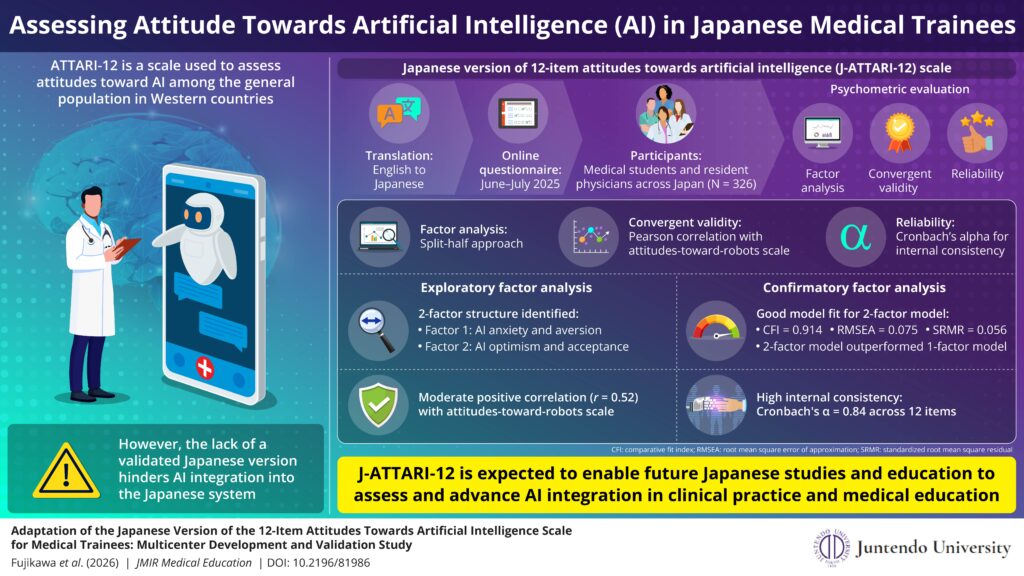
Image title: Attitudes Toward Artificial Intelligence in Medical Training: A Japanese Validation Study
Image caption: A new psychometrically validated scale that helps understand and support the integration of artificial intelligence in Japanese medical education.
Image credit: Hirohisa Fujikawa from Juntendo University Faculty of Medicine, Japan
License type: Original content
Usage restrictions: Cannot be reused without permission.
Artificial intelligence (AI) is rapidly transforming healthcare and medical education. From enhancing diagnostic accuracy and clinical decision-making to enabling virtual simulations and personalized learning, AI technologies are becoming embedded in the daily practice of clinicians and trainees. Despite these benefits, concerns remain regarding ethical responsibility, data privacy, the loss of human autonomy, and potential job displacement. As AI continues to expand across medical systems worldwide, understanding how future physicians perceive and engage with these technologies is increasingly important.
Attitudes toward AI play a critical role in determining whether AI tools are accepted, trusted, and effectively integrated into clinical practice and education. Positive attitudes promote openness and responsible use, whereas negative perceptions may lead to skepticism and underutilization. Accurate measurement of attitudes toward AI among medical students and residents is, therefore, essential for identifying barriers to adoption and designing effective educational interventions. In 2024, Stein and colleagues introduced the 12-item attitudes towards artificial intelligence (ATTARI-12) scale, a brief and reliable measure encompassing affective, cognitive, and behavioral dimensions. However, the absence of a validated Japanese version limited its applicability in Japan, where cultural factors—such as uncertainty avoidance and social norms—may influence responses to emerging technologies.
To address this gap, a team of researchers from Juntendo University, Japan—led by Project Assistant Professor Hirohisa Fujikawa and colleagues Dr. Hirotake Mori, Dr. Yuji Nishizaki, Dr. Yuichiro Yano, and Dr. Toshio Naito—collaborated with Dr. Kayo Kondo from Durham University, United Kingdom. Together, they developed and validated a Japanese version of the scale (J-ATTARI-12) for use among medical students and resident physicians. Dr. Fujikawa explained the motivation behind the study: “We observed wide variation in how learners responded to AI, yet no validated tool existed in Japan to measure these differences. This scale helps educators understand learners’ attitudes and better prepare future physicians for AI-enabled practice.” The results of their study were published in Volume 12, Issue e81986 of the journal JMIR Medical Education on January 14, 2026.
The study followed internationally recognized guidelines for translation and cross-cultural adaptation to ensure linguistic accuracy and cultural relevance. A nationwide online survey was conducted between June and July 2025, recruiting medical students and residents from multiple universities and hospitals across Japan. A total of 326 participants were included in the analysis. Psychometric evaluation employed a split-half validation approach: exploratory factor analysis (EFA) was conducted on one-half of the sample to identify the underlying factor structure, and confirmatory factor analysis (CFA) was performed on the other half to assess model fit. Convergent validity was examined by correlating J-ATTARI-12 scores with attitudes toward robots—a related construct—while internal consistency reliability was assessed using Cronbach’s α.
The analyses yielded several key findings. EFA identified a 2-factor structure reflecting “AI anxiety and aversion” and “AI optimism and acceptance.” CFA demonstrated that this 2-factor model showed good model fit and outperformed a one-factor model. Convergent validity was supported by a moderate positive correlation between J-ATTARI-12 scores and attitudes toward robots, and internal consistency reliability was high, indicating that the scale reliably measures attitudes toward AI among Japanese medical trainees.
The study offers important educational and research implications. Dr. Fujikawa noted, “Educators can use this scale to evaluate AI-related training and identify learners who may feel uncertain or hesitant about using AI. It also allows researchers to track how attitudes evolve as AI becomes more integrated into healthcare.” By providing a culturally adapted and psychometrically sound instrument, the J-ATTARI-12 supports data-driven curriculum development and informed decision-making in medical education.
Reflecting on the broader significance, Dr. Fujikawa emphasized, “The successful adoption of AI in healthcare depends on clinicians’ acceptance as much as on technological performance. Making these attitudes visible enables better education and more responsible implementation.” He added that the scale will be used in a “Medicine and AI” program launching at Juntendo University in 2026 and is expected to facilitate future cross-national research.
In conclusion, this study successfully developed and validated the J-ATTARI-12—the first Japanese instrument for assessing attitudes toward AI among medical students and residents. By providing a reliable and valid measure, it lays a strong foundation for advancing AI education, research, and integration within Japan’s medical training systems.
***
Reference
|
Authors |
Hirohisa Fujikawa1,2,3, Hirotake Mori1, Kayo Kondo4, Yuji Nishizaki1,5, Yuichiro Yano1, and Toshio Naito1 |
|
Title of original paper |
Adaptation of the Japanese Version of the 12-Item Attitudes Towards Artificial Intelligence Scale for Medical Trainees: Multicenter Development and Validation Study |
|
Journal |
JMIR Medical Education 2026;12:e81986 |
|
DOI |
|
|
Affiliations |
1 Department of General Medicine, Juntendo University Faculty of Medicine, Japan 2 Department of Medical Education Studies, International Research Center for Medical Education, Graduate School of Medicine, The University of Tokyo, Japan 3 Center for General Medicine Education, School of Medicine, Keio University, Japan 4 School of Modern Languages and Cultures, Durham University, United Kingdom 5 Division of Medical Education, Juntendo University School of Medicine, Japan |
***
About Project Assistant Professor Hirohisa Fujikawa
Hirohisa Fujikawa is a Project Assistant Professor in the Department of General Medicine, Juntendo University Faculty of Medicine, Japan. He holds an M.D. and a Ph.D. (2023) from The University of Tokyo and is an expert in health professions education. With over 10 years of academic and clinical experience, Dr. Fujikawa has published more than 90 peer-reviewed articles in international journals. His research focuses on ambiguity tolerance, working-hour restrictions for physicians, patient care ownership, workplace social capital, and the psychometric evaluation of educational instruments. He has served as the corresponding author on multiple multicenter studies, and has received competitive research funding and academic recognition for his contributions to the field of health professions education research.