Developing Human Resources and Giving Back to Society as a Leading Disaster Medicine Research Center in Japan
The Shizuoka Medical Research Center for Disaster was established in 2015 at Juntendo University Shizuoka Hospital after being selected for the Ministry of Education, Culture, Sports, Science and Technology’s “Program for Strategic Research Foundation at Private Universities.” Strategically located on the Izu Peninsula, the hospital is a designated disaster base facility playing a central role during major natural disasters such as earthquakes, typhoons, and a potential eruption of Mount Fuji. The Center leverages this location to conduct interdisciplinary research in disaster medicine, integrating clinical response, technology development, and training. We spoke with Director Dr. Koichi Sato about its current activities and future vision.
At its establishment, the Shizuoka Medical Research Center for Disaster was selected for two key research themes under the Ministry of Education, Culture, Sports, Science and Technology’s “Program for Strategic Research Foundation at Private Universities.” These themes focused on “Establishing an organizational structure to prepare for large-scale disasters” and “Developing a research infrastructure hub through fundamental studies on the prevention and treatment of injuries and illnesses during disasters and emergencies.” The Center strives to advance disaster prevention and mitigation by promoting disaster-resilient systems and medical technologies while fostering highly skilled professionals. In close collaboration with local government bodies, the Center conducts research that maximizes both the medical expertise of Juntendo University and the strategic advantages of Shizuoka Hospital’s location.
In addition to natural disasters, factors such as climate change resulting from human-driven environmental destruction, abnormal occurrences of wildlife and plant life, and the emergence of new viruses can also be regarded as forms of disaster. Such events place significant stress on the human body, potentially triggering illness or causing long-term health effects. The Center promotes research that integrates disaster response with clinical practice. As a leading institution in disaster medicine research in Japan, we are utilizing the full resources of Juntendo University to translate research findings into community benefit, foster highly skilled professionals, and contribute to building a safe and resilient society capable of effectively responding to disaster events.
Looking ahead, our objectives include continuing to conduct fundamental research on the prevention and treatment of injuries and illnesses during disasters and emergencies and to develop research frameworks and systems that incorporate educational approaches to disaster prevention and mitigation from a medical technology perspective, drawing on the collective expertise of all Juntendo University faculties. We also aim to establish a regional disaster prevention information network for medical care through collaboration between industry, academia, government, and the private sector, while contributing medical support to regional disaster prevention planning and risk management. In addition, we will carry out on-site surveys, information dissemination, and healthcare activities during large-scale disasters and promote research advancement by securing competitive funding to strengthen research infrastructure, facilities, and human resources.
The Center operates three research laboratories based on distinct themes: the Disaster Prevention Systems Laboratory, the Disaster Medicine Laboratory, and the Disaster Medicine Disease Model Laboratory.
The Disaster Prevention Systems Laboratory, headed by Dr. Youichi Yanagawa, Center Vice-Director and Professor of the Department of Emergency and Critical Care Medicine, focuses on research related to disaster medicine system management, the development of new technologies, the evaluation of education and training programs, and the construction of organizational frameworks. One of its projects involves demonstrating smart glasses that allow emergency medical personnel to transmit real-time images of patients to a remote hospital. The Disaster Medicine Laboratory, led by Dr. Koichi Sato, Center Director and Distinguished Professor of Surgery, conducts research on clinical management approaches, including the treatment of trauma patients commonly encountered during disasters, as well as the etiology and pathogenesis of diseases and complications arising in disaster settings. The Disaster Medicine Disease Model Laboratory, under the direction of Dr. Hiroshi Toshida, Senior Associate Professor of Ophthalmology, uses animal models to investigate substances that increase in the body due to trauma and stress and how elevated levels of these substances affect survival. The laboratory facilities include an animal testing room, an animal breeding room, a cell testing room, and two shared research rooms, all designated as BSL2 areas.
When the Center was first established, its initial research projects ran for five years, concluding in FY2019. Building on the outcomes of this period, the Center continued its research in FY2020 under the theme “Establishment of a Comprehensive Medical Care Delivery System for Large-Scale Disasters.” Each year, the Center invites research proposals from all departments at Juntendo University Shizuoka Hospital, welcoming a diverse range of researchers beyond physicians. It actively pursues improvements, including optimizing facilities and equipment and strengthening research and experimental systems. Additionally, the number of staff supporting testing and experiments has grown to 19 themes, involving 12 researchers—six times the number at the Center’s inception—creating a structure that enables robust research activities.
Two major research topics for FY2023 were presented at the Center’s progress meeting. The first involves the nation’s first use of smart glasses with communication capabilities in pre-hospital emergency response, developed through collaboration among medical, fire, and private sectors. Emergency medical teams wear the smart glasses during patient care from the moment the injured person is placed in the ambulance until arrival at the hospital. The glasses transmit information on the patient’s condition, monitor waveforms, and indicate injury location to the receiving hospital. Although the initial trial revealed some instability in the communication environment, it demonstrated the system’s potential to reduce pre-hospital emergency response times and enable rapid coordination for patient acceptance at the hospital, thereby supporting lifesaving efforts. A second trial is planned using an improved version of the smart glasses with a more stable communication system, with the expectation that the technology will also be applicable in disaster scenarios.
The second research project focuses on developing a novel treatment for widespread skin ulcers caused by various traumatic injuries, which are likely to occur during disasters. The team has established a method to induce differentiation of adipose tissue–derived stem cells into epidermal keratinocyte-like cells, allowing for relatively easy collection in large quantities. To evaluate the effectiveness of these cells, they were applied to the skin of a mouse model of dystrophic epidermolysis bullosa, a severe disease in which a mutation in the type VII collagen gene disrupts anchoring fibers connecting the epidermis and dermis, causing the epidermis to peel easily across the body. The treatment successfully suppressed blister formation and restored anchoring fibers, resulting in positive experimental outcomes and the acquisition of a patent. Supported by the Juntendo Medical Technology Innovation Center, verification experiments are ongoing with the goal of achieving clinical application.
The Center, located within Juntendo University Shizuoka Hospital, is accessible to all hospital staff, including pharmacists and nurses. While research remains a central focus, the Center also prioritizes developing skilled human resources capable of effective disaster response by involving staff in collaborative disaster research and promoting information sharing. Beyond the smart glasses trials and the development of novel treatments for skin ulcers, the Center is advancing research on disaster-related diagnosis and education, including projects such as the diagnosis of patients with locomotive syndrome and musculoskeletal instability in disaster victims and the development of a disaster nursing education program utilizing educational technology.
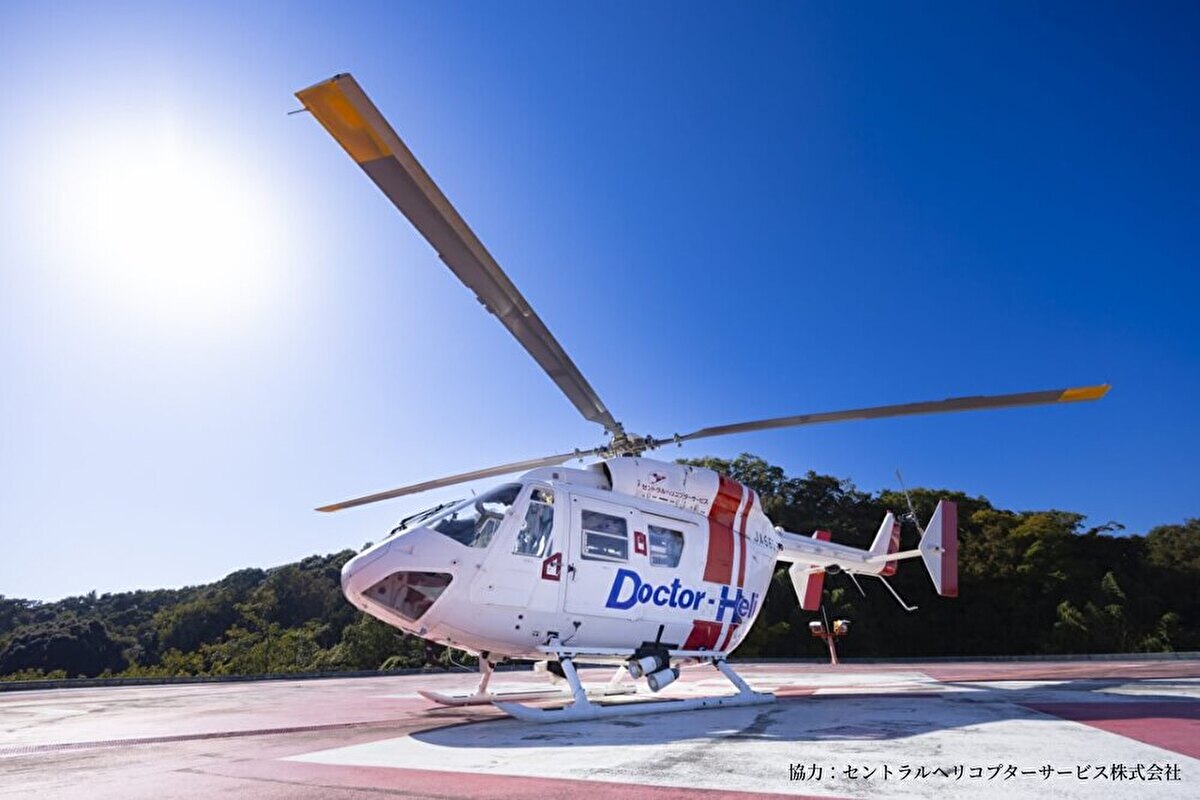
Juntendo University Shizuoka Hospital serves as a disaster base hospital for the prefecture, featuring an Emergency and Critical Care Center, a Comprehensive Perinatal Maternal and Child Medical Center, and a doctor helicopter covering central and eastern Shizuoka Prefecture, including the Izu Peninsula. The hospital actively engages the community through public lectures and other events. The Center will continue to share research findings on the prevention and treatment of injuries and illnesses during disasters and emergencies with local residents, while advancing human resource development and contributing to society as a leading institution in disaster medicine research.
Director, Shizuoka Medical Research Center for Disaster, Juntendo University Graduate School of Medicine
Dr. Sato began his clinical training at Juntendo University Hospital in 1981 and studied in the Department of Surgery at the University of Muenster, Germany, in 1988. He became a surgeon at Shizuoka Hospital in 1995, was appointed Clinical Professor of Surgery in 2007, and promoted to Professor of Surgery in 2013. He served as Vice-Director of the hospital in 2014 and became Director of the Shizuoka Medical Research Center for Disaster in 2015. Since 2019, he has also been Director of Shizuoka Hospital and, since 2021, Project Professor of Upper Gastrointestinal Surgery.
Research Center